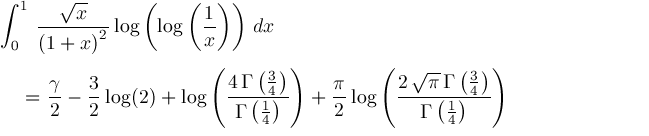
Generally, I like Adamchik's paper. The most interesting proposition is Proposition 1 which Adamchik attributes to G. Almkvist and A. Meurman. The proofs for Adamchik's Proposition 3, Proposition 5, and Proposition 6 are more drawn out and tortured than necessary. My theorem below is proved in less space and generalizes half the propositions in Adamchik's paper. Definition of Two FunctionsDefinition.
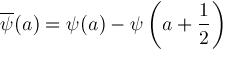
Function
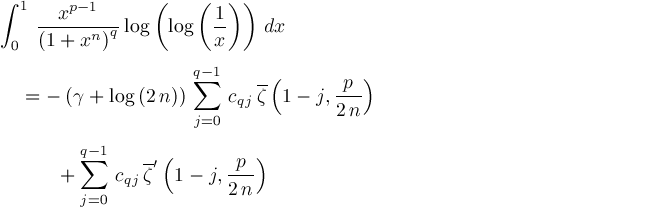
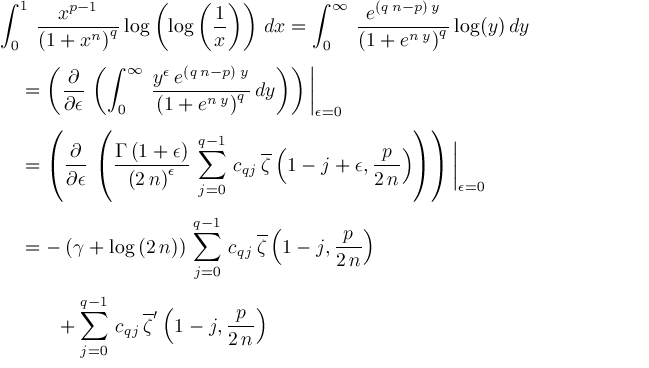
The following theorem generalizes Adamchik's Proposition 3, Proposition 5, and Proposition 6. Generalization of Adamchik's Propositions 3, 5, and 6Theorem.
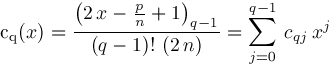
where coefficients
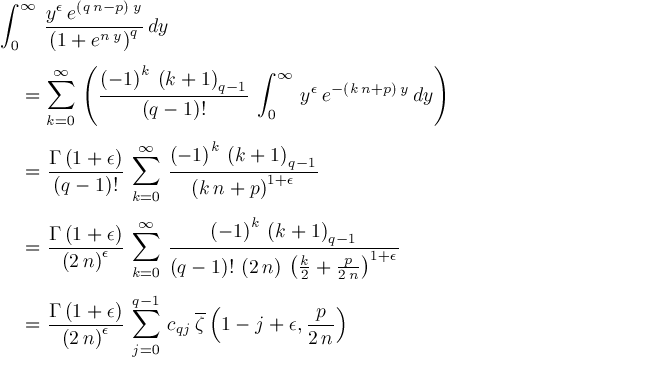
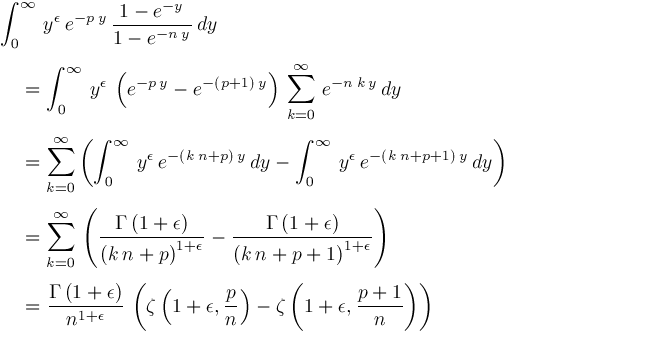
Proof.
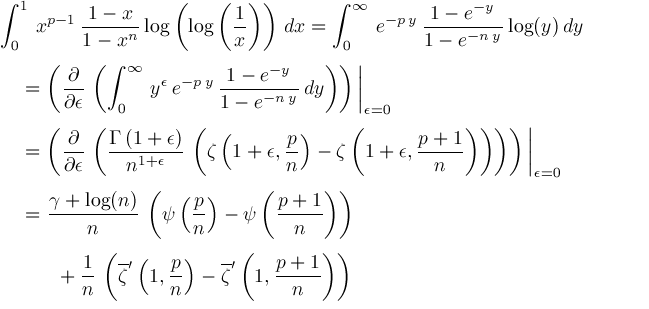
We get
Therefore,
Comment.
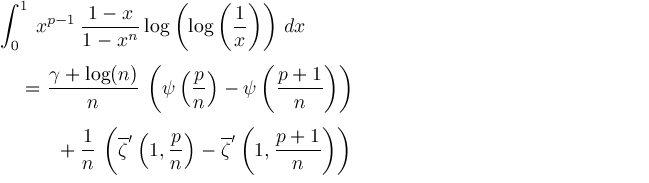
Adamchik's Proposition 4The proof for Adamchik's Proposition 4 can also be simpler: Theorem.
Proof.
References
The first reference is Victor Adamchik's paper. The other
|

|
Jun 10, 2005 - Generalization of Adamchik's Formulas
|
 This note (


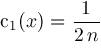
 For convenience, define
 has properties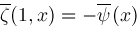

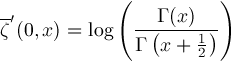
 are determined by
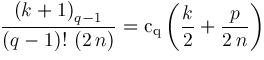

 are
are
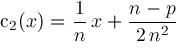


 and
and
 functions.